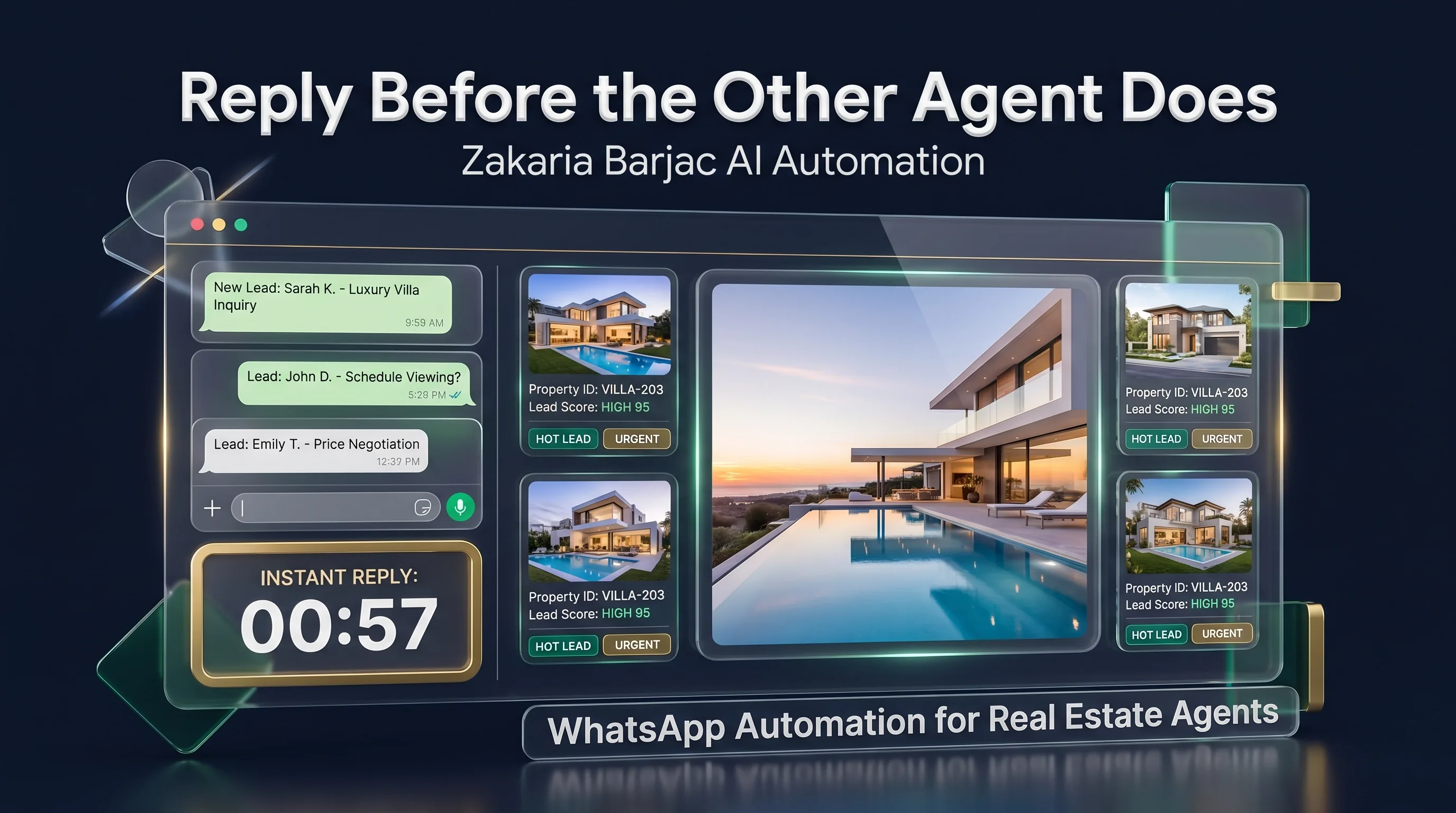
WhatsApp automation helps real estate agents respond to property enquiries before competitors do.
In 2026, a property lead often doesn't pick up the phone. They send a WhatsApp message to the agent on the listing photo, then to the agent on the next listing, and sometimes to a third for good measure. Whichever agent replies first with the unit specs and a viewing slot tends to win the appointment. The others often get no response at all.
The directional pattern is well known among working agents: speed of first reply matters a great deal in the early window of a property enquiry. If your average WhatsApp response time is well over five minutes — especially after-hours — there's a meaningful chance you're losing leads to faster competitors.
WhatsApp automation can close that gap, when designed thoughtfully and disclosed to the buyer.
Why this problem matters
A few structural reasons fast WhatsApp response is one of the highest-leverage moves an agent can make:
- Property portals push leads in real time. Buyers send messages at all hours — evenings, late at night, Sunday mornings. They tend to expect a response in minutes, not the next business day.
- First reply often gets the viewing. Multiple agents bid for the same lead. Whoever replies first with the specs and a slot is in a strong position to book the viewing.
- Lead acquisition costs are not trivial. If you're paying for portal leads or paid social ads, slow replies effectively subsidise the competition's pipeline.
The pattern shows up in agent workflows: agents who track first-reply time tend to find their median is much higher than they expect, especially over weekends.
How WhatsApp automation works for property leads
The system isn't a chatbot pretending to be the agent. It's a layered response stack.
Layer 1: Instant acknowledgement. A lead's message arrives. The AI replies within roughly a minute with a personalised acknowledgement using the lead's name and the specific listing they enquired on. The message identifies the property, confirms the agent will follow up personally, and asks a small number of qualifying questions (timeline, budget range, finance status).
Layer 2: Qualification. The lead replies. The AI scores the lead (hot, warm, cold), pulls comparable listings if relevant, and queues the conversation for the agent. Hot leads can trigger an alert to the agent's phone.
Layer 3: Agent takeover. The agent steps in personally, sees the full conversation history, and continues the conversation. The AI never pretends to be the agent — when the agent takes over, that should be obvious to the lead.
Layer 4: Follow-up loop. If the lead goes cold, a soft follow-up sequence can be configured (new listings matching the brief, market updates), with the agent's approval over the content.
The key principle: AI handles the speed; the human handles the relationship.
What to automate first
| Automation area | Why it matters | Reasonable first step |
|---|---|---|
| Instant first reply | The single biggest win — being first into the conversation | AI auto-replies to portal-sourced enquiries the moment they arrive |
| Lead qualification | Saves agent time on tyre-kickers | AI asks budget, timeline, and finance status as part of the first reply |
| Listing match suggestions | Keeps cold leads warm without manual effort | Agent-approved match suggestions sent on a managed cadence |
| Viewing reminders and confirmations | Reduces no-show viewings | Automated confirmations the day before, with an easy reschedule path |
| Post-viewing follow-up | A consistent follow-up tends to lift conversion | Auto follow-up after the viewing, asking for feedback |
A common starting point: instant first reply. Everything else is a multiplier on a leak that needs plugging.
Common mistakes to avoid
- Letting the AI pretend to be the agent. Disclose that the first reply is automated. Buyers tend to respect speed; they don't tend to forgive deception.
- Robotic acknowledgements. “Thank you for your enquiry” is dead language. Use the lead's name, the listing address, and an honest follow-up question.
- No human handoff timer. A hot lead waiting an extended period for the human agent loses momentum. Set an alert for unattended hot leads.
- Skipping qualification. Replying instantly to unqualified leads can waste more agent time than slow replies. Qualify briefly on the first AI message.
- Mass-sending listing matches. Property messaging crosses into spam quickly. Send a small number of highly relevant matches, not many generic ones.
Cost and ROI considerations
Costs vary by scope and platform choice. The honest framing: WhatsApp automation tends to pay back when the agent or agency has steady inbound lead volume from portals or paid channels and a known gap on first-reply speed.
It's less compelling for agents who do almost everything by referral or who already maintain consistently fast response times.
We recommend benchmarking your last 30 days of first-reply times before committing.
When this is a good fit
- Agent or agency with steady inbound lead volume from portals or paid channels
- Most leads are messaging-first rather than phone-first
- Current first-reply time is materially slow, especially after-hours and over weekends
- Agency wants centralised lead routing across multiple agents
When this is not a good fit
- Agent doing very few deals per year — manual reply is faster than the system
- Pure referral-based agent with little portal traffic
- Agent who is unwilling to disclose AI in the chat — better to skip than risk reputation
Privacy and regulatory considerations
WhatsApp automation should be designed with applicable privacy laws in mind, including the Protection of Personal Information Act in South Africa. Specific compliance depends on how lead data is collected, stored, and shared, and on the messaging policies of the platform you build on. Consult a legal or compliance adviser before going live.
Operationally, the messaging platform you build on imposes its own policies. Workarounds that violate platform terms can result in numbers being banned. Build on supported, sanctioned approaches.
How Zakaria Barjac AI Automation can help
We build messaging-automation systems for service businesses, including real estate agencies. A typical engagement covers the messaging platform setup, the instant-reply layer with listing-specific personalisation, lead scoring, the agent handoff, and a soft follow-up loop.
We also work with the agent on the handoff playbook so the AI-to-human transition feels natural rather than jarring.
For related context, see our pieces on AI lead qualification, missed-call text-back, automated appointment booking, and our regional guide on what Cape Town businesses should automate first.
Book a free strategy call → — we'll review your last 30 days of WhatsApp first-reply times and discuss what's realistically possible.