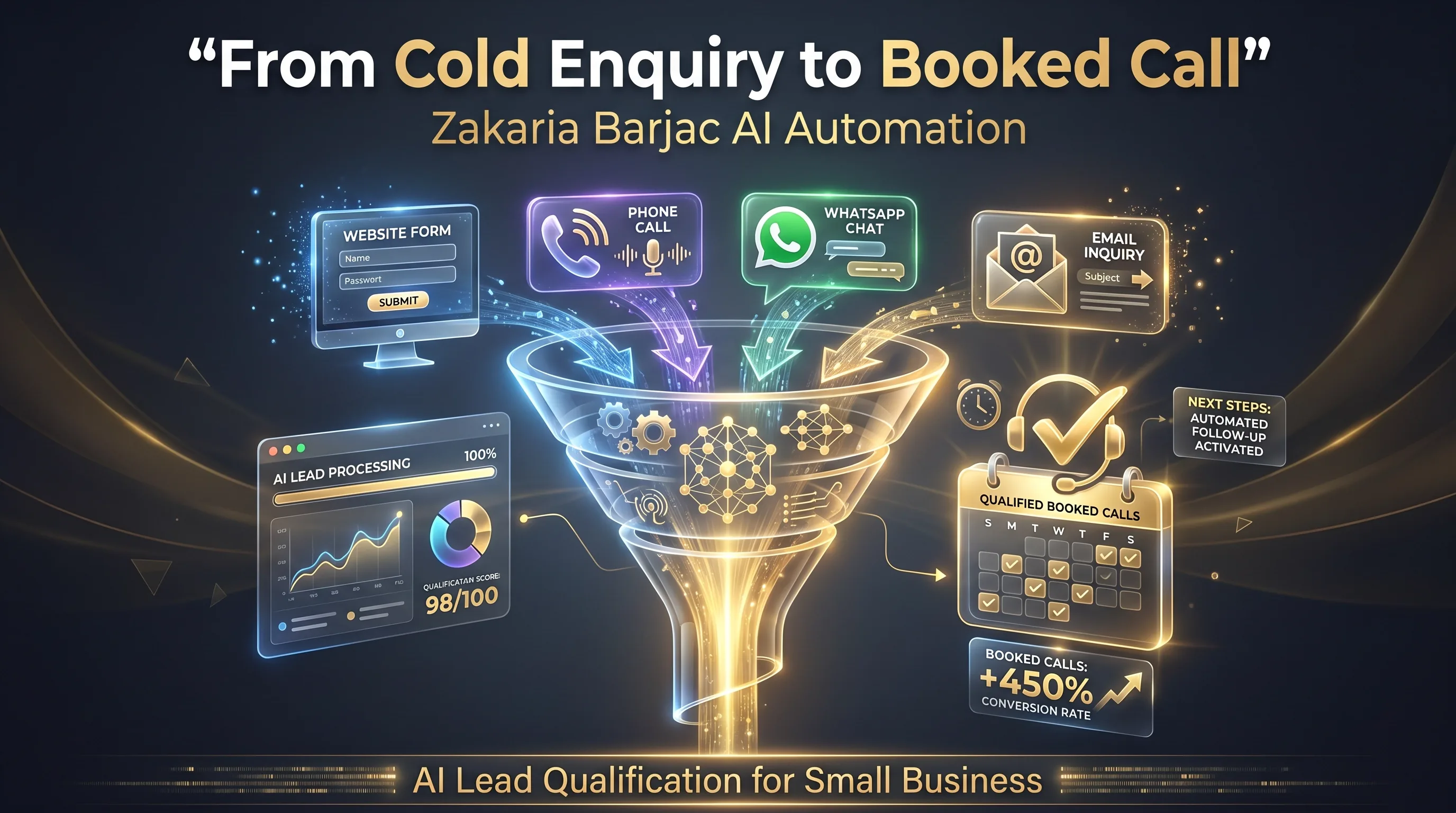
AI lead qualification turns website, phone, email, and chat enquiries into qualified booked calls.
Many small businesses lose a meaningful share of their pipeline in the gap between “a lead enquired” and “a lead is on the call.” The first 5–30 minute window after enquiry tends to be the highest-conversion moment, and it's also the moment where most small teams are stuck doing something else.
AI lead qualification closes that gap. It captures the enquiry, asks smart qualifying questions, scores the lead, and offers a calendar slot — all within minutes, all without your salesperson lifting a finger.
This article is a practical guide for small business owners considering whether AI qualification fits their setup.
Why this problem matters
Three reasons the qualification gap is one of the highest-leverage places to apply automation:
- Speed of first reply matters disproportionately. Across many service categories, the first business to respond captures most of the booking. Slow replies effectively subsidise the competition.
- Manual qualification doesn't scale. A salesperson who personally qualifies every lead is a salesperson with a hard ceiling on how many leads they can handle. Automation removes that ceiling without adding headcount.
- Cold leads die quietly. Leads who don't book on day one tend to disappear unless a follow-up sequence runs. Manual sequences get forgotten; automated ones don't.
How AI qualification works
The flow is conceptually simple: capture → score → ask smart questions → offer slots → book or route.
- Capture. Lead arrives via your contact form, messaging app, email, or phone.
- First reply. AI acknowledges within roughly a minute, using the lead's name and the specifics of their enquiry. Discloses it's an automated assistant.
- Qualification. AI asks a small number of qualifying questions — typically budget, timeline, and a fit indicator specific to your business.
- Scoring. Responses are scored against your ideal-customer profile. Hot leads are routed differently from cold ones.
- Offer. Hot leads see a calendar with available slots. Cold leads enter a nurture sequence with light-touch content.
- Handoff. When a lead books, your sales team gets the full conversation context — history, answers, score — via CRM or alert.
BANT vs ICP-fit vs hybrid scoring
Three common scoring frameworks, with rough fit by business type:
| Framework | What it measures | Best fit |
|---|---|---|
| BANT (Budget, Authority, Need, Timeline) | Sales-readiness signals | Higher-ticket B2B services with longer cycles |
| ICP-fit scoring | How closely the lead matches your ideal customer profile | Productised services where fit predicts conversion |
| Hybrid (BANT + ICP) | Both readiness and fit, weighted | Most well-defined SME service businesses |
Most small businesses we discuss this with end up on a hybrid model. Pure BANT misses good-fit leads who aren't ready yet (and would have converted later). Pure ICP-fit treats a perfect-fit cold lead the same as a perfect-fit ready-to-buy lead.
What to automate first
| Automation area | Why it matters | Reasonable first step |
|---|---|---|
| Form-to-booking flow | Highest-volume enquiry source for most SMEs | AI replies to form submissions instantly with qualification questions |
| Messaging-to-booking | Increasingly the channel buyers prefer | Same flow, on your messaging platform |
| Email-to-booking | Lower-volume but often higher-value enquiries | AI parses inbound email, replies, qualifies, offers slot |
| Cold-lead nurture | Recovers leads that didn't book on day one | Light, helpful content over 14–30 days; clear opt-out |
Common mistakes to avoid
- Asking too many questions. 3–5 qualifying questions max before offering a slot. More than that and conversion drops fast.
- Over-aggressive scoring. Marking too many leads “cold” means your salesperson sees fewer leads, but the wrong ones often slip through anyway.
- No fallback to human. Every flow needs a clear path to a real person if the lead requests one or the AI gets stuck.
- Pretending to be human. Disclose. Buyers tend to forgive automation; they don't forgive deception.
- No opt-out. Every automated message should have a clear way to stop receiving them. This is good practice and supports compliance with applicable privacy laws.
Cost and ROI considerations
Costs vary by scope, integration depth, and lead volume. The honest framing: AI qualification tends to pay back when there's clear evidence of leakage — slow first-reply times, dropped enquiries, leads getting lost between channels. If your team already replies to every enquiry within minutes and has high booking conversion, the upside is smaller.
We recommend benchmarking your current first-reply time and booking conversion before committing to scope.
When this is a good fit
- 50+ enquiries per month across forms, messaging, and email
- A defined ideal-customer profile
- Current first-reply time is materially slow
- The salesperson is the bottleneck, not the lead supply
When this is not a good fit
- Walk-in retail or pure foot traffic
- Ultra-low-ticket impulse purchases where qualification adds friction without value
- No defined ICP — qualifying against an undefined target produces noise
Privacy and regulatory considerations
AI lead qualification systems should be designed with privacy and regulatory requirements in mind, including the Protection of Personal Information Act (POPIA) in South Africa and equivalent rules in other jurisdictions. Specific compliance depends on how lead data is collected, stored, processed, and shared, and should be reviewed with your own legal or compliance adviser before going live.
How Zakaria Barjac AI Automation can help
We build lead-qualification systems for small businesses. A typical engagement covers the universal-inbox capture layer, AI scoring against your ICP, the booking flow, and the cold-lead nurture sequence. We work on your existing tools where they have documented APIs and use hybrid approaches where they don't.
For related context, see WhatsApp automation for real estate agents, automated appointment booking, AI missed call text back, and our regional guide on AI automation for South African SMEs.
Book a free strategy call → to map the highest-leverage automation in your specific lead flow.