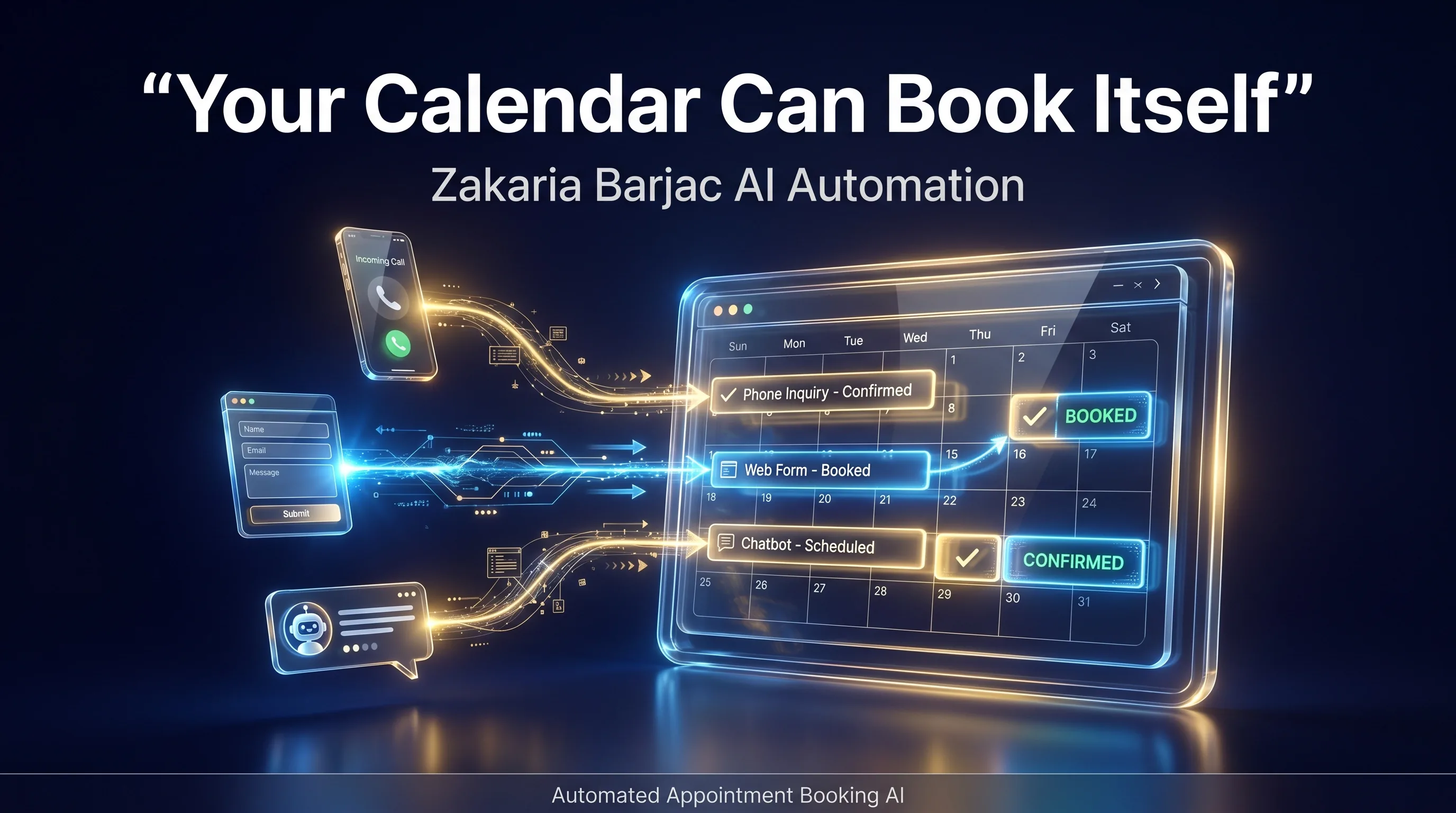
Automated appointment booking lets AI capture leads and fill the calendar while the business owner works.
The booking gap — that stretch between “interested” and “booked” — is one of the most common revenue leaks in service businesses. Every step between “a customer wants to book” and “an appointment is on the calendar” tends to lose a portion of leads. Phone tag. Voicemail. Email lag. Form submissions that nobody saw until tomorrow.
Automated appointment booking removes most of those steps. Done well, it captures the lead, checks live availability, offers a slot, confirms the booking, and sends reminders — all without your front-of-house lifting a finger.
This article is a practical guide for service business owners considering whether AI booking is worth exploring.
Why this problem matters
Three reasons the booking gap is consistently underestimated:
- Each step drops a portion of customers. Phone-to-voicemail-to-callback drops more than half the leads at each step. Form-to-email-to-reply drops similar shares.
- The customer's intent decays fast. Someone ready to book at 9pm is meaningfully less ready to book at 9am the next day. Same person, different decision.
- Manual booking creates errors. Wrong day, wrong time, double-booking — every manual step is an error opportunity.
How AI booking works
The flow is conceptually simple: capture → calendar check → 2-option offer → confirmation → reminder loop.
- Universal capture. Lead arrives via phone, messaging, web chat, email, SMS, or contact form. The AI handles all channels in the same pipeline.
- Identify and confirm. For known customers, AI confirms identity. For new ones, captures the basics.
- Live availability check. AI queries your calendar in real time to see what's actually open.
- 2-option offer. AI presents a small number of specific slot options. Too many options reduces conversion.
- Confirmation. Customer picks one. AI confirms and writes the appointment to your calendar immediately.
- Reminder loop. Reminder messages a day or two before, plus a closer-in reminder. Easy reschedule path.
What to automate first
| Channel | Why it matters | Reasonable first step |
|---|---|---|
| Phone | Often the highest-volume channel for service businesses | AI voice answer with booking flow during overflow and after-hours |
| Messaging | Increasingly first-touch for younger demographics | Instant reply with qualifying questions and slot offer |
| Web form | Predictable, structured data | AI parses and replies with slot offer within minutes |
| Lower-volume but often higher-value | AI parses inbound, suggests slots, confirms via email reply |
No-show prevention
Booking is half the battle. The other half is the customer actually showing up. Three things consistently reduce no-show rates:
- Reminder loops. 48-hour and 4-hour reminders reduce no-shows materially in most service businesses.
- Easy reschedule. Customers who can reschedule with one tap usually reschedule rather than no-show.
- Deposit collection. For high-value slots, a small refundable deposit makes the customer 3–5x more likely to show up.
Common mistakes to avoid
- Too many slot options. Paradox of choice — three options convert better than ten.
- No buffer time. Back-to-back bookings without buffer create stress and quality drops.
- No reschedule path. Forcing customers to call to reschedule means they no-show instead.
- Ignoring time zones. For cross-border services, time zone bugs are the #1 cause of bad bookings.
Cost and ROI considerations
Costs vary by scope and integration depth. The honest framing: automated booking pays back when there's evidence of booking leakage — phone tag, slow form replies, no-show rates above 8–10%. Practices already at near-zero leakage have less to gain.
When this is a good fit
- Service businesses with 50+ bookings per month
- Digital calendar that can be integrated
- Identified leakage — missed calls, slow replies, or no-show rates above 8–10%
When this is not a good fit
- Walk-in only or pure foot-traffic businesses
- Ultra-flexible scheduling (no fixed slots)
- Group classes where booking logic is more complex than 1-to-1
Privacy and regulatory considerations
Automated booking systems should be designed with privacy and regulatory requirements in mind, including POPIA in South Africa and equivalent rules elsewhere. Specific compliance depends on configuration and should be reviewed with your own legal or compliance adviser.
How Zakaria Barjac AI Automation can help
We build automated booking systems for service businesses. A typical engagement covers the universal-capture layer, calendar integration where APIs allow, the messaging confirmation, and the reminder loop with reschedule and (optional) deposit collection.
For related context, see AI receptionist for doctors, AI receptionist for dental clinics, AI lead qualification, and missed-call text-back.
Book a free strategy call → — we'll review your current booking flow and discuss what's realistically possible.