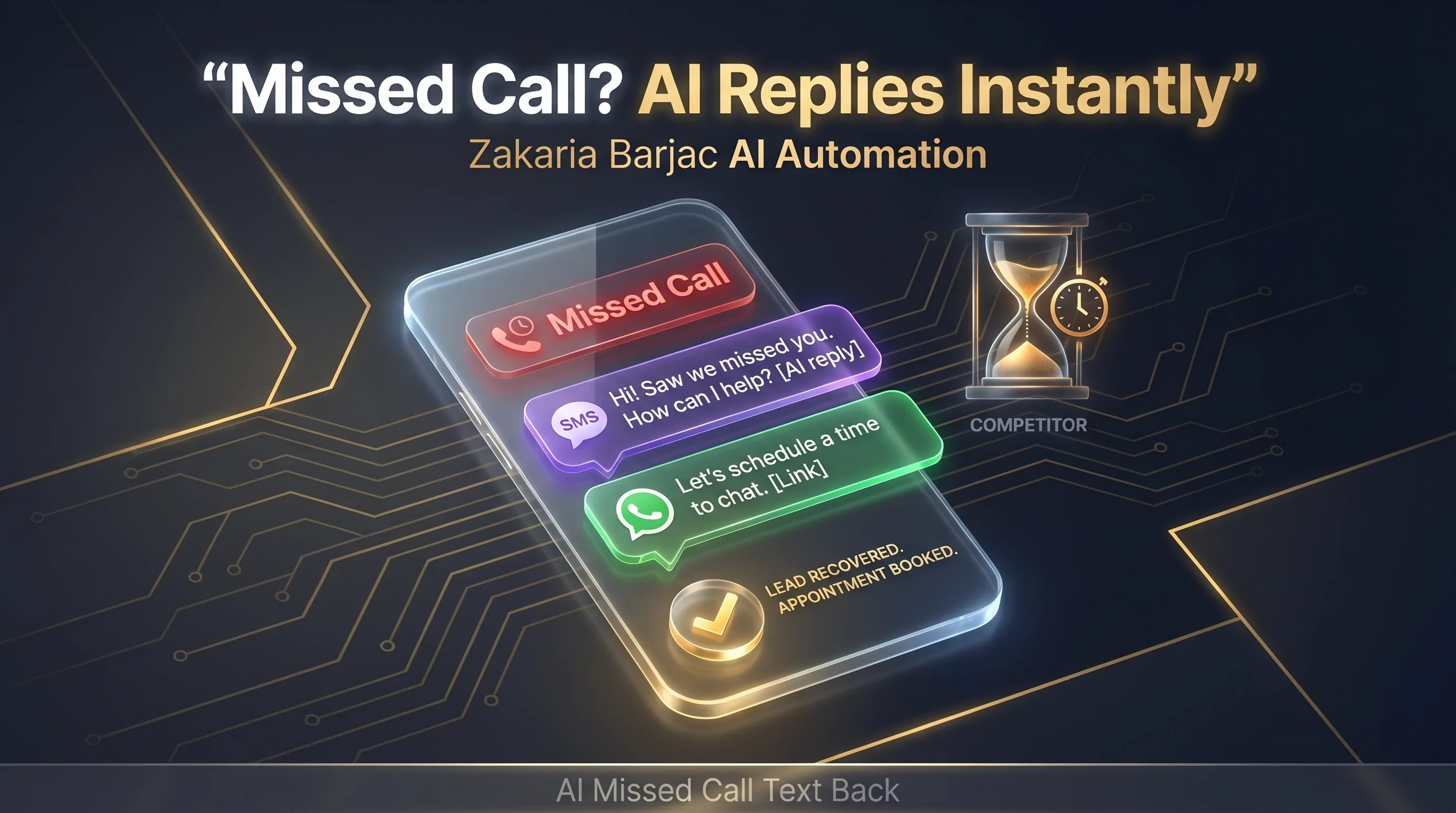
AI missed-call text-back systems help recover leads quickly before they contact a competitor.
Missed calls are silent money. The customer who tried to reach you and got voicemail doesn't tell you they tried. They just hang up and try the next business on the search results page. There's no entry in your CRM, no record of the lost opportunity, no signal that anything went wrong.
Missed-call text-back closes that loop. The moment a call is missed, an automated SMS or messaging-app reply goes out, acknowledging the call and offering an immediate path to book or get help. Done well, it recovers a meaningful share of leads who would otherwise have been lost.
This article is a practical guide for any service business with phone-based enquiries.
Why this problem matters
Three reasons missed-call leakage is one of the easiest revenue leaks to plug:
- Voicemail callback rates tend to be modest. Most service businesses see only a small share of voicemail messages getting returned. The rest just disappear.
- The next business is one search away. A customer with an immediate need who reaches voicemail will typically call your competitor within minutes.
- It costs almost nothing to fix. Compared with most automation, missed-call text-back is a small build with disproportionate impact.
How missed-call text-back works
The flow is simple: missed call detected → SMS or messaging follow-up sent within seconds → AI engages on reply → books or routes.
- Detection. Your phone system or AI receptionist identifies a missed call.
- Instant SMS. Within roughly 30 seconds, the customer receives an SMS apologising for the missed call and inviting them to book or message back.
- Engagement. If the customer replies, the AI engages naturally — qualifies the enquiry, offers a booking slot, or routes to a human.
- Routing. Hot leads go to your team via CRM or alert. Cold leads enter a soft nurture if appropriate.
Channel split: SMS first, messaging app for follow-up
SMS is the right channel for the first message because virtually every phone supports it. Messaging-app conversations work well as a follow-up channel because they're richer (images, links, longer messages) and customers tend to engage longer in them. Most well-designed systems use SMS for the first contact and messaging apps for the ongoing conversation.
What the SMS should say
Four tone-templates that tend to work, depending on your business:
| Style | Example tone | Best for |
|---|---|---|
| Apology | “Sorry we missed your call — what can we help with?” | Most service businesses |
| Identification | “You reached [business]. We're back online and can help — just reply.” | Multi-location or branded operations |
| Action | “You can book directly here: [link] or reply with your question.” | High-booking businesses (clinics, salons) |
| Urgency | “Sorry we missed you — we have a slot available today at [time]. Want it?” | Trades with last-minute capacity |
Common mistakes to avoid
- Generic messages. “Sorry we missed your call. Please call back.” — useless. Use the customer's name if you have it, the business name, and an action.
- No AI follow-up on reply. If the customer replies and nobody (or no system) replies back, you're worse off than not sending the SMS.
- Sending during do-not-disturb hours. A 2am SMS damages trust. Configure quiet-hours.
- No opt-out. Every message should have a clear opt-out (e.g. reply STOP).
Cost and ROI considerations
Costs vary by scope and SMS volume. The honest framing: missed-call text-back is one of the cheapest automations to build and tends to pay back fast when there's a real missed-call problem. If your team already answers nearly every call live, the upside is smaller.
When this is a good fit
- Any service business with phone-based enquiries
- Particularly: clinics, real estate, trades (plumbers, electricians), salons, professional services
- Regular pattern of missed calls during busy or after-hours periods
When this is not a good fit
- Businesses where every customer prefers a phone callback over SMS (rare in 2026 but exists)
- Regulated environments with strict messaging restrictions that make automated SMS impractical
Privacy and regulatory considerations
Automated SMS systems should be designed with applicable privacy and consumer-protection rules in mind, including POPIA in South Africa and equivalent rules elsewhere. Specific compliance depends on how customer data is collected, stored, and used, and should be reviewed with your own legal or compliance adviser. A clear opt-out path on every automated message is good practice and supports compliance with most applicable rules.
How Zakaria Barjac AI Automation can help
We build missed-call text-back systems for service businesses. A typical engagement covers detection setup, the instant-SMS layer, AI engagement on reply, routing to your team, and optional booking integration.
For related context, see AI receptionist for doctors, AI receptionist for dental clinics, WhatsApp automation for real estate agents, and automated appointment booking.
Book a free strategy call → — we'll review your current call patterns and discuss the realistic recovery upside.