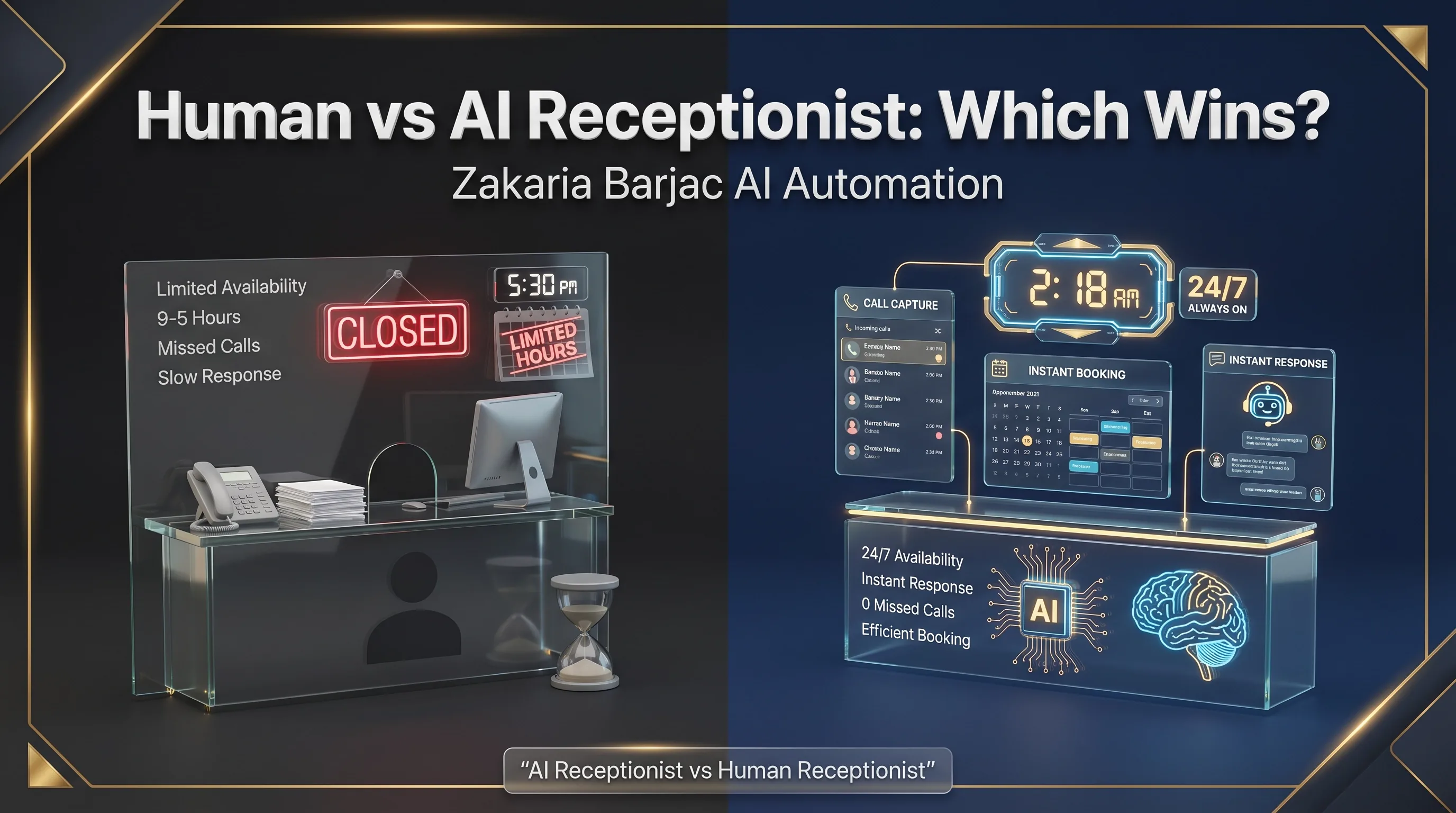
Comparing AI receptionists and human receptionists helps businesses understand coverage, cost, and response speed.
The choice between an AI receptionist and a human receptionist is rarely an either-or decision. Most well-designed setups in 2026 use both — AI handling the predictable, high-volume work and humans handling the nuanced, relationship-driven moments where they add the most value. This article is a practical comparison for service business owners weighing where each fits.
Why this question matters
Three reasons it's worth comparing carefully rather than picking by gut:
- The cost gap is real but smaller than vendors often claim. AI is meaningfully cheaper at scale, but the savings depend on call volume and integration complexity, not on a marketing brochure.
- Coverage gaps cost more than people think. Calls that go to voicemail tend to leak to competitors silently. Whether you fix that with AI, more humans, or a hybrid, the gap is the bigger problem than which tool you use.
- Edge cases matter disproportionately. The 5% of calls that need human nuance can be more important to your business than the 95% that don't.
The honest comparison
The dimensions that tend to matter most for service businesses, with directional rather than absolute claims:
| Dimension | Human | AI | Hybrid |
|---|---|---|---|
| Cost per call at high volume | Higher fixed labour cost | Generally lower | Mid-range |
| Coverage hours | Limited to staffing | Can cover 24/7 | 24/7 with human escalation |
| Average response speed | Variable (live), or voicemail | Very fast on first reply | Very fast first reply, human follow-up |
| Empathy and nuance | Strong | Functional, improving | Strong where it's needed |
| Booking accuracy on routine cases | High with experienced staff | High | High |
| Edge case handling | Strong | Weaker — needs escalation | Strong via escalation path |
| Sick days and leave | Yes | No | No |
| Loadshedding / outage exposure | Office-bound | Cloud-hosted, with caveats around your local internet | Failover layer recommended |
| Training and ramp time | Weeks for a new hire | Days to weeks for configuration | Comparable to AI alone |
The dimensions are directional; actual outcomes depend on your call volume, the complexity of your service, and how the system is configured. Vendors that promise specific percentage savings without seeing your call data are guessing.
When the AI tends to win outright
- Overflow and after-hours calls. The hours your reception desk isn't covered are often the hours customers most need to reach you.
- Repeat scripts and routine queries. “What are your hours?”, repeat appointment bookings, simple FAQs.
- Reminders and confirmations. No-show prevention is a high-volume, low-skill task that AI handles well.
- Missed-call recovery. Auto-message any caller who didn't connect, inviting them to book or message back.
When the human tends to win outright
- Complex billing or insurance disputes. Conversations involving judgement, escalation, and account history are still firmly human territory.
- Emotionally sensitive calls. A grieving family, a worried parent — these need human presence, not pattern-matched dialogue.
- Clinical or true emergencies. AI should recognise and route, never attempt to handle.
- VIP relationships. The customers who make up a disproportionate share of your revenue often want a familiar voice.
The hybrid model
The pattern that most service businesses end up with: AI as the front line, humans as the escalation layer. AI takes every call, handles the routine work directly, and routes the calls that need a human to a real person via a callback queue or live transfer.
This setup tends to work because it plays to both strengths. AI is patient, fast, available, and scalable. Humans are warm, judgement-driven, and trusted. Putting them in series rather than in competition gives the customer the best experience for whatever they need that day.
Common mistakes to avoid
- Replacing your best receptionist. Almost always the wrong move. The best receptionists do work AI can't — relationships, in-person, complex billing. Redeploy, don't replace.
- Skipping the soft-launch. Run AI alongside humans for the first week or two and review every transcript before going fully live.
- Marketing AI as a human. Disclose. Customers tend to forgive automation; they don't forgive deception.
- Assuming the savings claim without an audit. A 30-day call-volume audit before buying anything is the cheapest insurance.
Cost considerations
The honest framing: cost savings depend on your current call volume, your missed-call rate, and how labour-intensive your front desk currently is. Practices with high call volume and meaningful after-hours leakage typically see the biggest financial case for AI. Practices that already answer nearly every call live and have low no-show rates have less to gain.
Costs typically fall into a one-off setup component (configuration, scripting, integration) and a monthly running component (platform, telephony, support). Specific pricing depends on scope and is discussed during scoping.
Privacy and regulatory considerations
AI receptionists handling personal or health data should be designed with privacy and regulatory requirements in mind, including POPIA in South Africa and any sector-specific guidance such as HPCSA. Specific compliance depends on configuration and should be reviewed with your own legal or compliance adviser before going live.
How Zakaria Barjac AI Automation can help
We build hybrid receptionist systems for service businesses, including dental and medical practices. A typical engagement covers the AI voice agent, the human escalation path, the messaging confirmation layer, and a soft-launch period to review transcripts before going fully live.
For industry-specific deep-dives, see AI receptionist for dental clinics for after-hours patient capture in private dental practice, and AI receptionist for doctors for overflow and after-hours call handling in medical practices. Related operational pieces: AI missed call text back and automated appointment booking.
Book a free strategy call → — we'll review your call patterns and discuss whether a hybrid model is the right fit for your business.